Blog · Managing your diary
Recurring appointments: how to set up a series clients never have to rebook
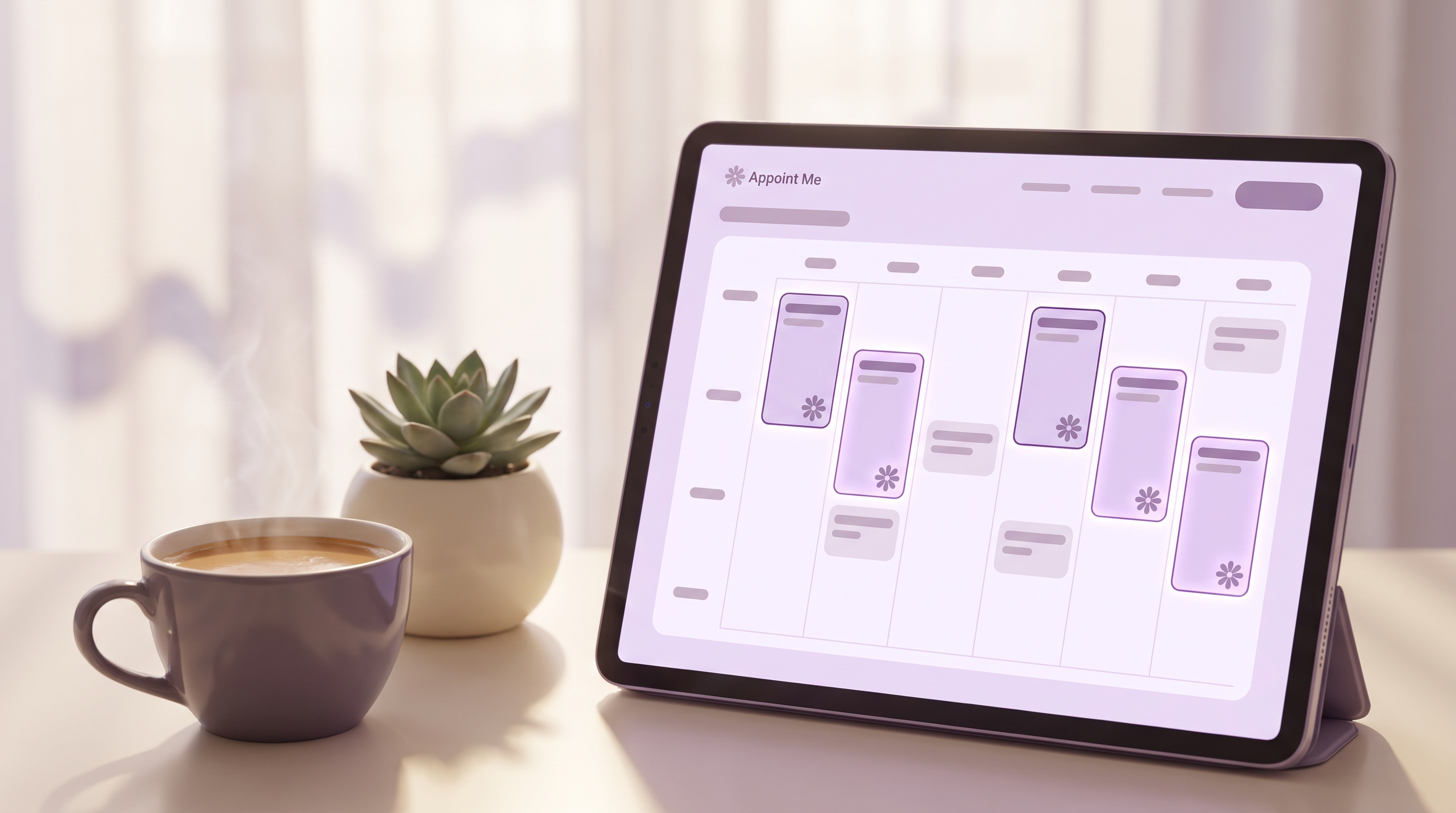
A recurring appointment is a single booking that repeats automatically on a set pattern — weekly, fortnightly, monthly, or however the work naturally falls — so a client's next slot is already reserved the moment the last one finishes. For any business built on repeat visits, from a tutor seeing the same student every Tuesday to a physiotherapist running a six-week course of treatment, that one setting removes an entire round of rebooking admin, for both sides of the diary.
Which appointment businesses run on recurring visits
Far more diary-led work is cyclical than people tend to notice. A tutor sees a pupil at the same time every week for a school term. A personal trainer sees a client two or three times a week for months at a stretch. A hairdresser sees a colour client every six to eight weeks, and a barber sees a regular every fortnight. A physiotherapist or counsellor often works in a defined course of sessions, spaced a set number of days apart. A dental or GP practice recalls patients for a check-up on a fixed interval, usually six or twelve months out. A beauty therapist rebooks facial or lash clients on a three to four week cycle almost by default.
None of that is a one-off booking that happens to repeat by coincidence — it is the actual shape of the business. Treating every one of those visits as a fresh, standalone booking means re-entering the same client, the same service and the same time slot again and again, and hoping nobody forgets to do it.
How a recurring series works day to day
The mechanics are simple once they are set up correctly. A client is booked into a series rather than a single appointment: the practitioner picks a start date, a pattern (every week, every fourth Tuesday, every six months) and, where relevant, an end point or a number of sessions. The diary then fills in every future instance of that slot at once, and each one behaves as its own appointment — it can be moved, cancelled or have notes added without touching the rest of the series.
That last part matters more than it sounds. A client on holiday for one week of a monthly series should be able to skip that single visit and keep every future date exactly where it was, rather than the whole series being cancelled and rebuilt from scratch. Good booking software treats each occurrence as independent while keeping the pattern intact underneath, so a practitioner can see at a glance which regulars are booked in for the coming month without opening a dozen separate entries.
Keeping flexibility without losing the routine
A recurring series should never mean a client is locked in. Pausing a series while someone finishes a course of treatment elsewhere, extending it once a GP referral is renewed, or simply changing the day of the week a fortnight in — all of that needs to be a quick edit, not a cancel-and-start-again. The point of automating the pattern is to remove the admin of repetition, not to remove the ability to adapt it.
Why recurring bookings help with retention
A client with a standing slot already in their calendar is a client who has to actively decide to cancel, rather than one who has to actively decide to rebook. That is a meaningfully different position to be in. Every time a business asks a client to come back and book again from scratch, there is a moment where the appointment can simply not happen — a forgotten prompt, a fortnight that slips by, a moment of "I'll sort it next week" that quietly becomes never. A recurring series removes that moment entirely for as long as the pattern holds.
It also smooths out the diary from the practitioner's side. A week that is already half-filled with known regulars is a week with far less empty space to chase, and far more certainty about income and workload before it even begins.
What to look for in booking software for recurring appointments
Not every booking system handles recurring visits well, and it is worth checking before relying on one for a diary that runs on repeat clients. The useful features tend to be:
- True series booking — one setup action that creates the whole pattern, not a client or a member of staff manually repeating the same entry every week.
- Independent editing per visit — the ability to move, cancel or add notes to a single occurrence without disturbing the rest of the series.
- Automatic reminders on every instance — each occurrence in the series sends its own confirmation and reminder, exactly as a standalone booking would.
- Staff-level and resource-level patterns — a recurring slot tied to a specific practitioner or treatment room, so the series still works correctly in a multi-staff diary.
- Pause and resume — a way to hold a series without deleting it, for the client who needs a break rather than a cancellation.
- Client self-service — clients can see their own upcoming series and request a change, rather than every adjustment needing a phone call.
Appoint Me, the feel-good booking system, is built with recurring series as a core booking type from the outset — usable by a tutor, a therapist, a clinic or a salon alike, rather than treated as a feature bolted on for one industry and ignored for the rest.
Recurring patterns by business type
| Business type | Typical recurring pattern | What automation removes |
|---|---|---|
| Tutor | Weekly, same day and time | Rebooking the same slot every week of term |
| Personal trainer | Two or three times a week | Manually scheduling each session individually |
| Hairdresser or barber | Every four to eight weeks | Remembering to prompt the client to rebook |
| Physiotherapist or counsellor | A fixed course of sessions | Re-confirming every visit in the course by hand |
| Dental or GP practice | Six or twelve-month recall | Recall admin and chasing patients individually |
| Beauty therapist | Every three to four weeks | Losing clients who simply forget to rebook |
| Counsellor or ongoing therapy | Weekly, indefinitely | Protecting the same regular time slot each week |
Setting a series up properly from the start
The best time to set a client up on a recurring pattern is the very first time the pattern becomes clear — the second or third visit in, once it is obvious this is a regular rather than a one-off. Ask the client directly what cadence suits them, set the series there and then, and confirm the end point or review date if there is one. From that point on, the diary does the remembering, the reminders go out on their own, and the only conversations left are the ones that actually need a human: a change of day, a pause, or simply catching up at the next visit.
Related reading
How to write an appointment cancellation policy clients actually follow
A clear cancellation policy sets one notice period, says what happens to deposits and shows before booking. How to write one for any appointment business.
1 October 2026
Appointment reminders that work: timing, wording and templates
The best times to send appointment reminders, what to say, and ready-to-adapt templates for clinics, therapists, tutors, salons and barbers.
20 August 2026
Moving from a paper diary to an online booking system: a practical guide
Move from a paper diary to an online booking system in five practical steps — what to copy across, when to switch, and how to bring clients with you.
30 July 2026Run a salon, spa, clinic or practice?
Appoint Me is the feel good booking system for every appointment business.
See what Appoint Me does